Fairfield County · Residential Market Research
The Inventory Era.
Fairfield, CT · May 2026 · 18 min read · By KeyLedger Research
Why fewer homes are selling for more across Fairfield, Westport, and Greenwich — and what 22 years of recorded sales reveal about where the market is heading.
Inventory has collapsed.
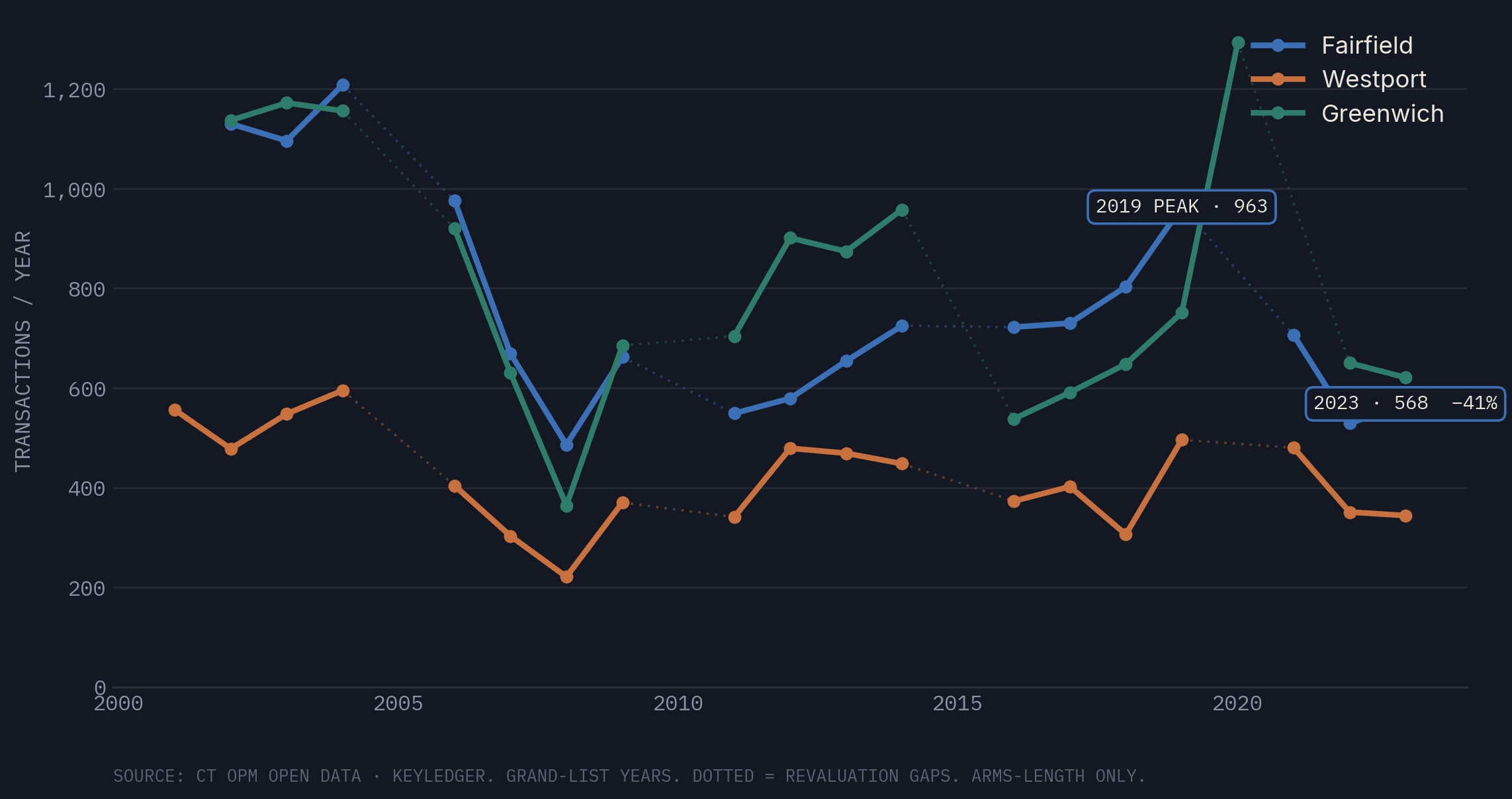
Transactions are down 17–41% from the 2019 peak across all three towns while prices keep climbing. Scarcity, not demand, is doing the work.
The cause is rate-lock.
Roughly two-thirds of U.S. mortgages sit below 4%. Owners won't trade a 3% loan for a 7% one, so inventory never reaches the market. The move-up chain is frozen.
A hidden address premium.
Across the full series, Westport and Greenwich each price ~12–13% above an equivalent Fairfield home — invisible in any single year because assessments lag the market 18–36 months.
Inventory has collapsed
The single most important fact in the Fairfield County market today is not the price level — it is the scarcity of transactions. Since 2019, the number of homes changing hands each year has fallen 17–41% depending on town.
Sales volume is collapsing while prices climb
Annual arms-length residential transactions per town.
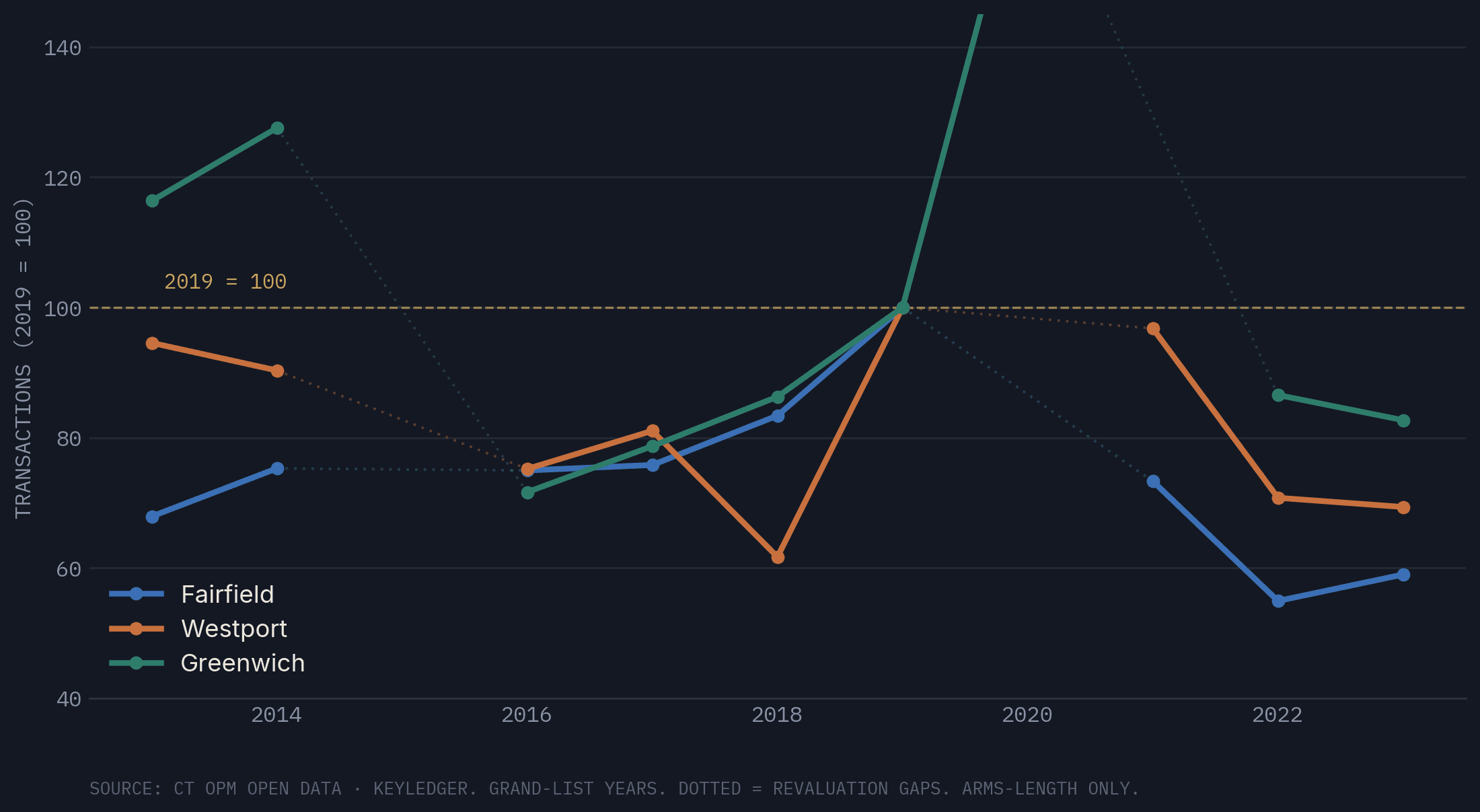
Indexed to 2019, the contraction is unmistakable and town-wide.
Inventory has dried up
Transactions indexed to 2019 = 100. Greenwich is most resilient; Fairfield most constrained.
Why: the rate-lock effect
A homeowner who refinanced at 3% in 2020–21 faces a powerful disincentive to sell — trading into a 7% loan can raise the monthly payment on an equivalent home by 50% or more. The move-up market freezes, inventory never reaches the MLS, and the homes that do list attract competitive bids. This is the mechanism behind "fewer sales, higher prices."
Fewer homes, each worth more
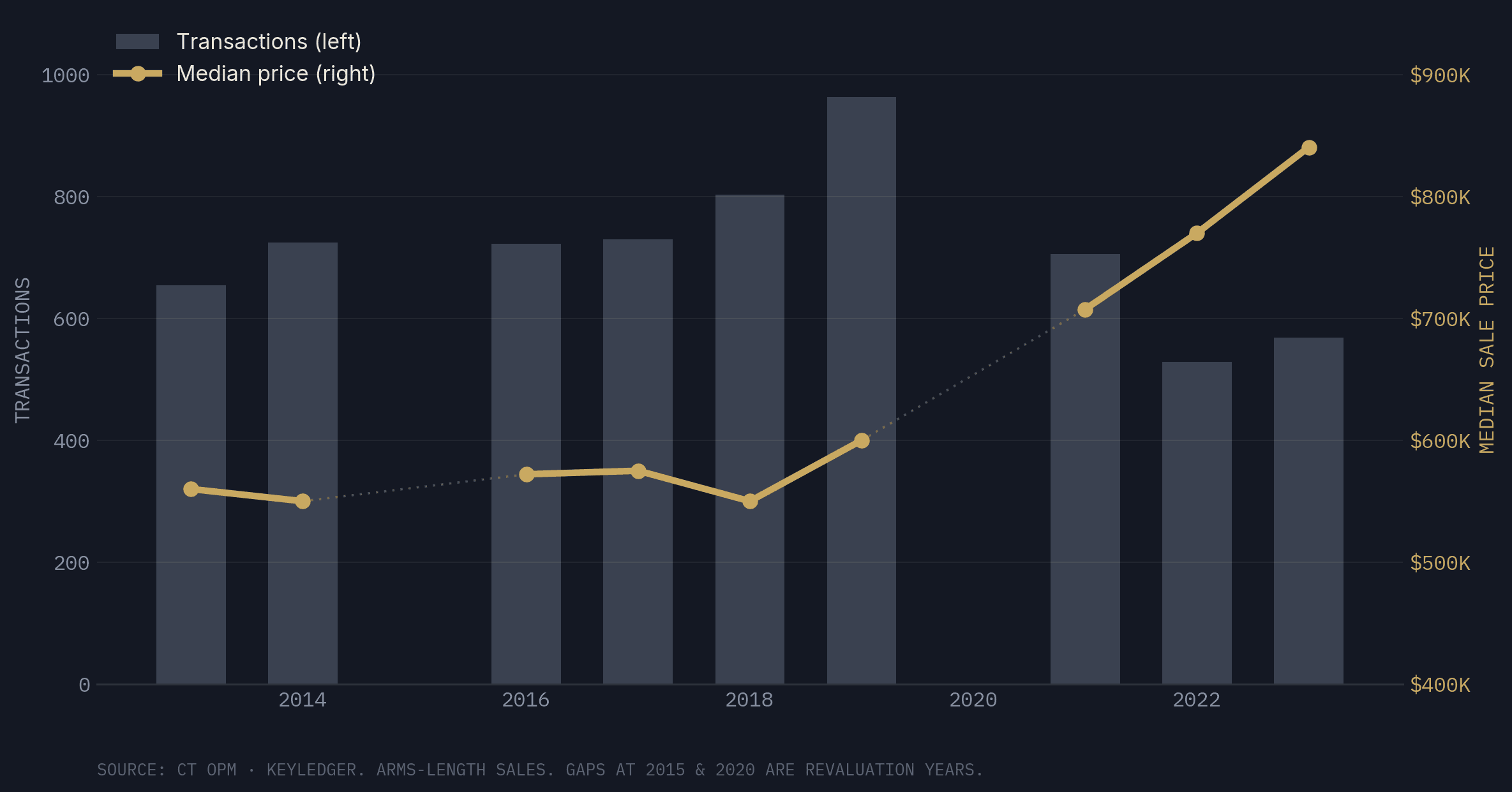
When volume and price move in opposite directions you get a "scissors" — the defining shape of a supply-constrained market. In Fairfield, the median rose ~50% from 2013 to 2023 even as transactions fell.
The scissors: Fairfield price vs volume
Transaction count (bars) against median price (gold), 2013–2023.
Where the dollars are
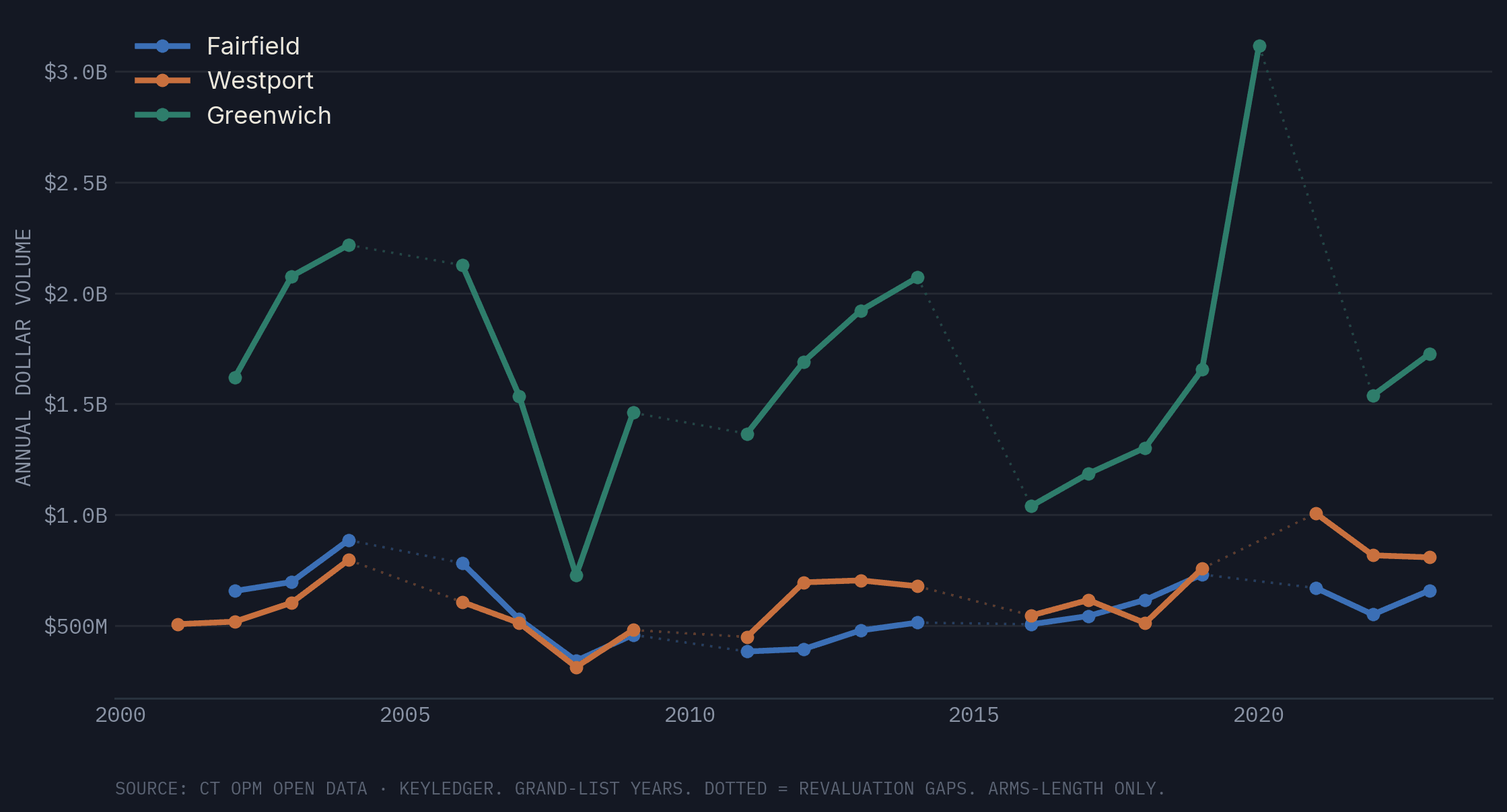
Fewer transactions doesn't mean less money. Because prices rose, total dollar volume has held up — and in Greenwich it remains enormous: $1.5B–$3.1B in residential sales per year. The Greenwich market is roughly 2.5× the size of Fairfield's by dollars transacted.
Fewer deals, bigger tickets
Total annual dollar volume of arms-length residential sales.
Three towns, three trajectories
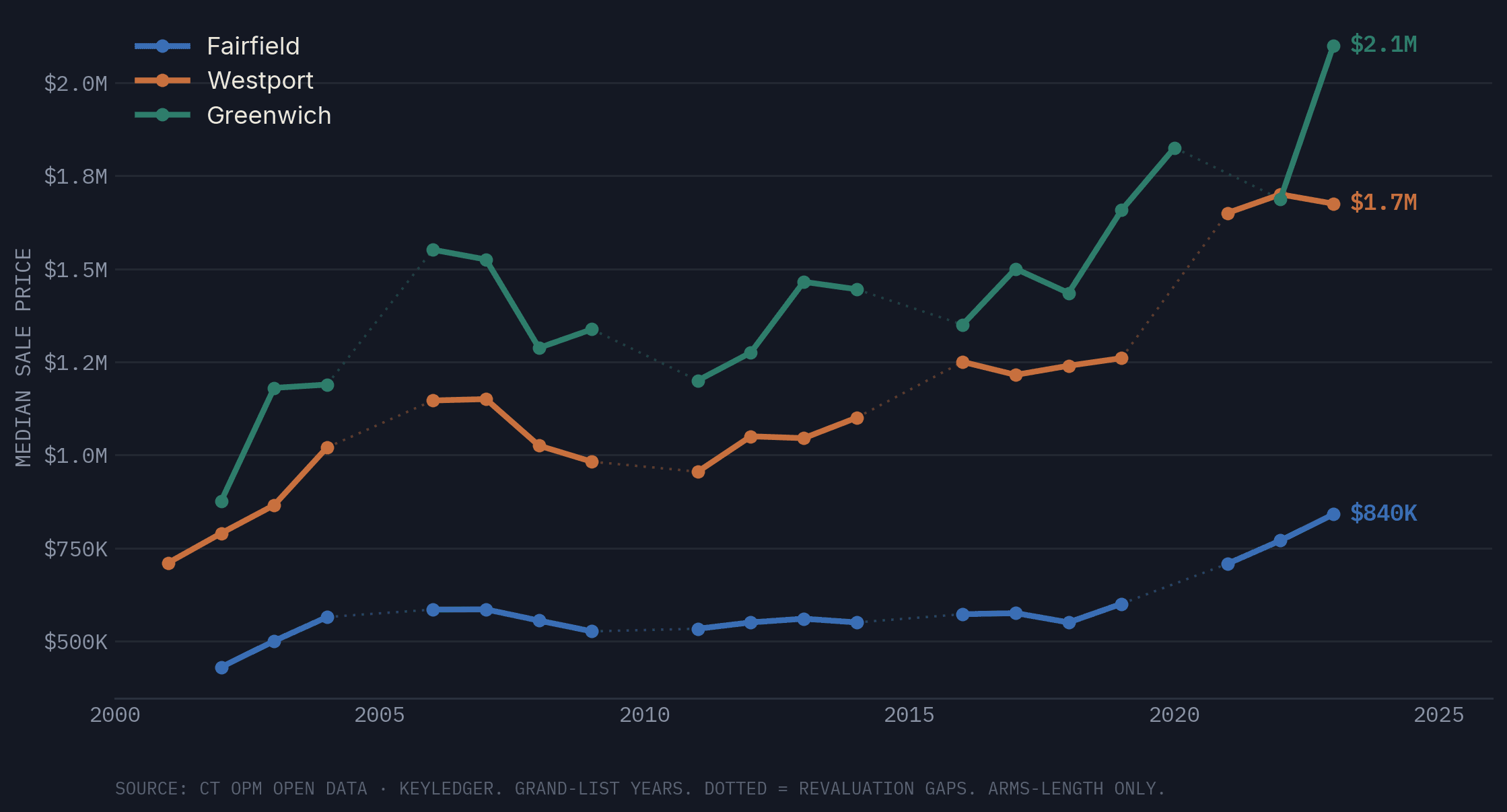
The three towns form a price ladder that has widened over 22 years. Greenwich crossed a $2.1M median in 2023; Westport sits near $1.7M; Fairfield near $840K.
Median sale price — three tiers, widening
Median sale price by grand-list year, all three towns.
“A buyer pays 12–13% more for the same house, by the numbers, for the address.”
The premium you can't see in one year
Are Greenwich and Westport simply more expensive towns, or do they command a premium beyond what the homes themselves justify? A hedonic regression across the full 2001–2023 series (48,855 sales), controlling for assessed value, type, and year, answers it.
The real premium
Residual premium over an equivalent Fairfield home, after controls. Both p<0.001.
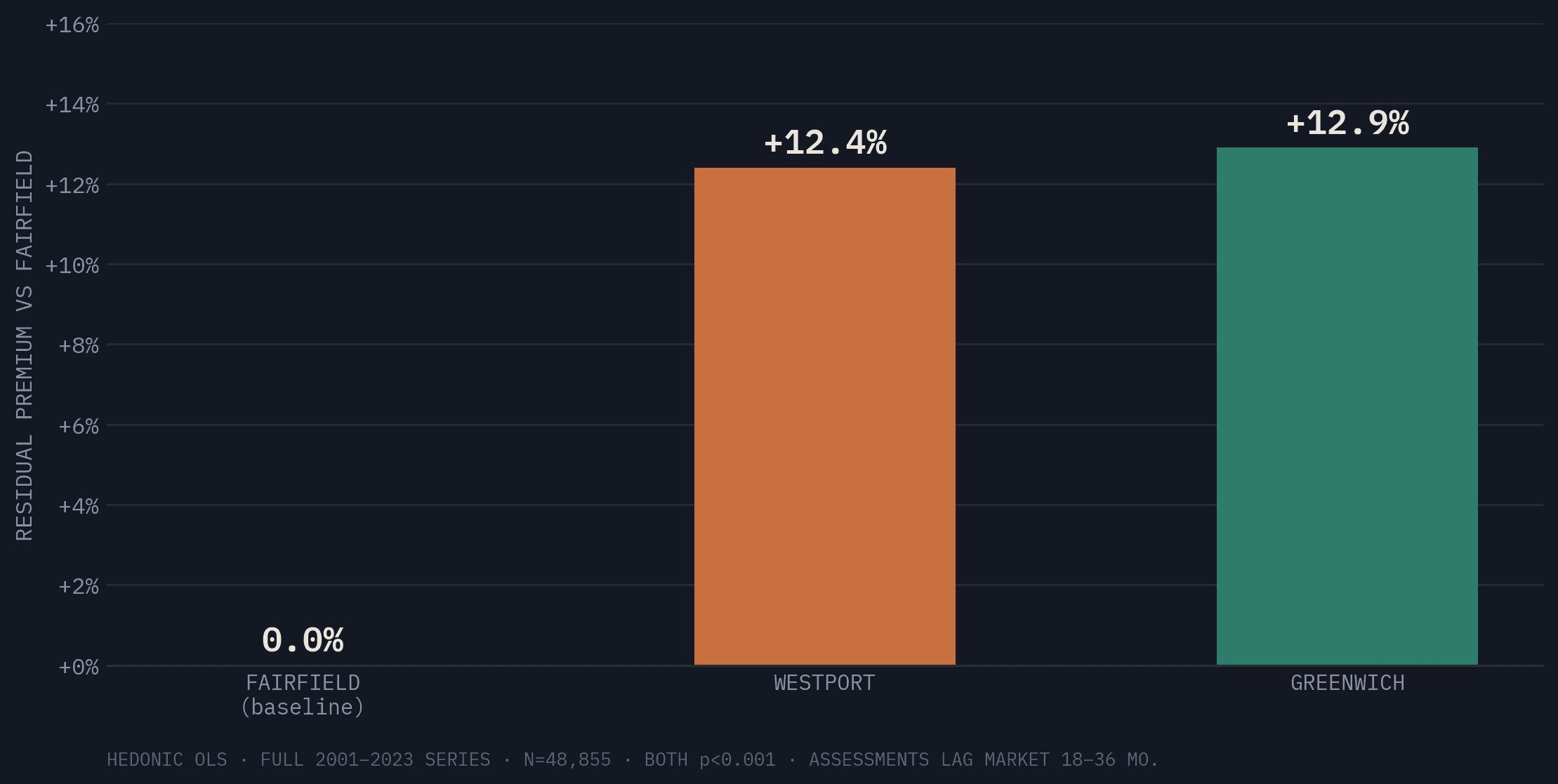
Both Westport (+12.4%) and Greenwich (+12.9%) carry a persistent residual premium. Crucially, it is invisible in any single recent year, because town assessments lag market peaks by 18–36 months. That lag is itself an opportunity: in the window after a peak but before reassessment, well-timed buyers can find relative value.
Micro-markets and the road ahead
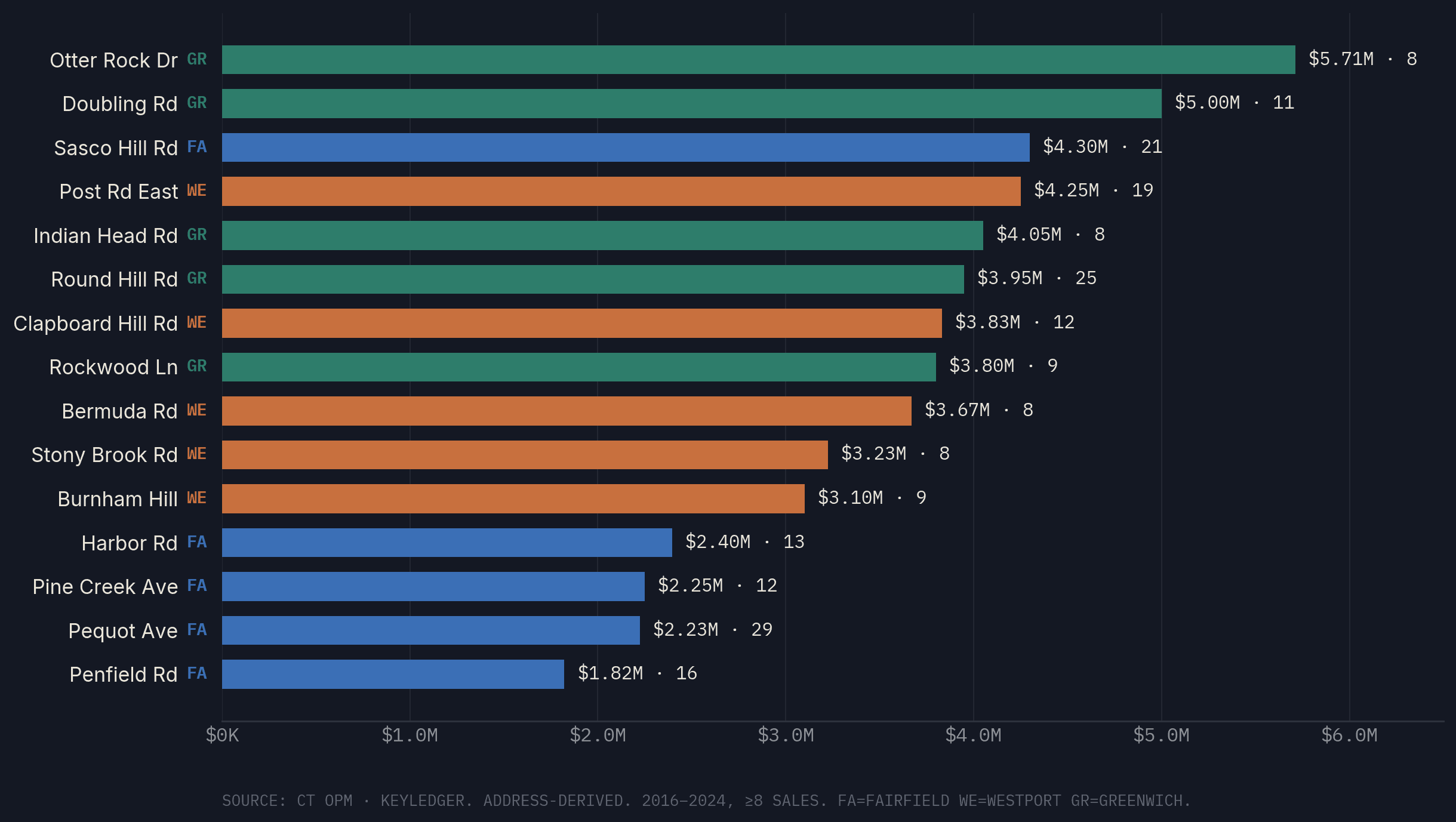
The same transaction record supports street-level analysis and a forward projection. The trophy-street leaderboard spans all three towns; Greenwich tops it near $5.7M.
Trophy streets across all three towns
Top streets by median sale price, 2016–2024 (≥8 sales).
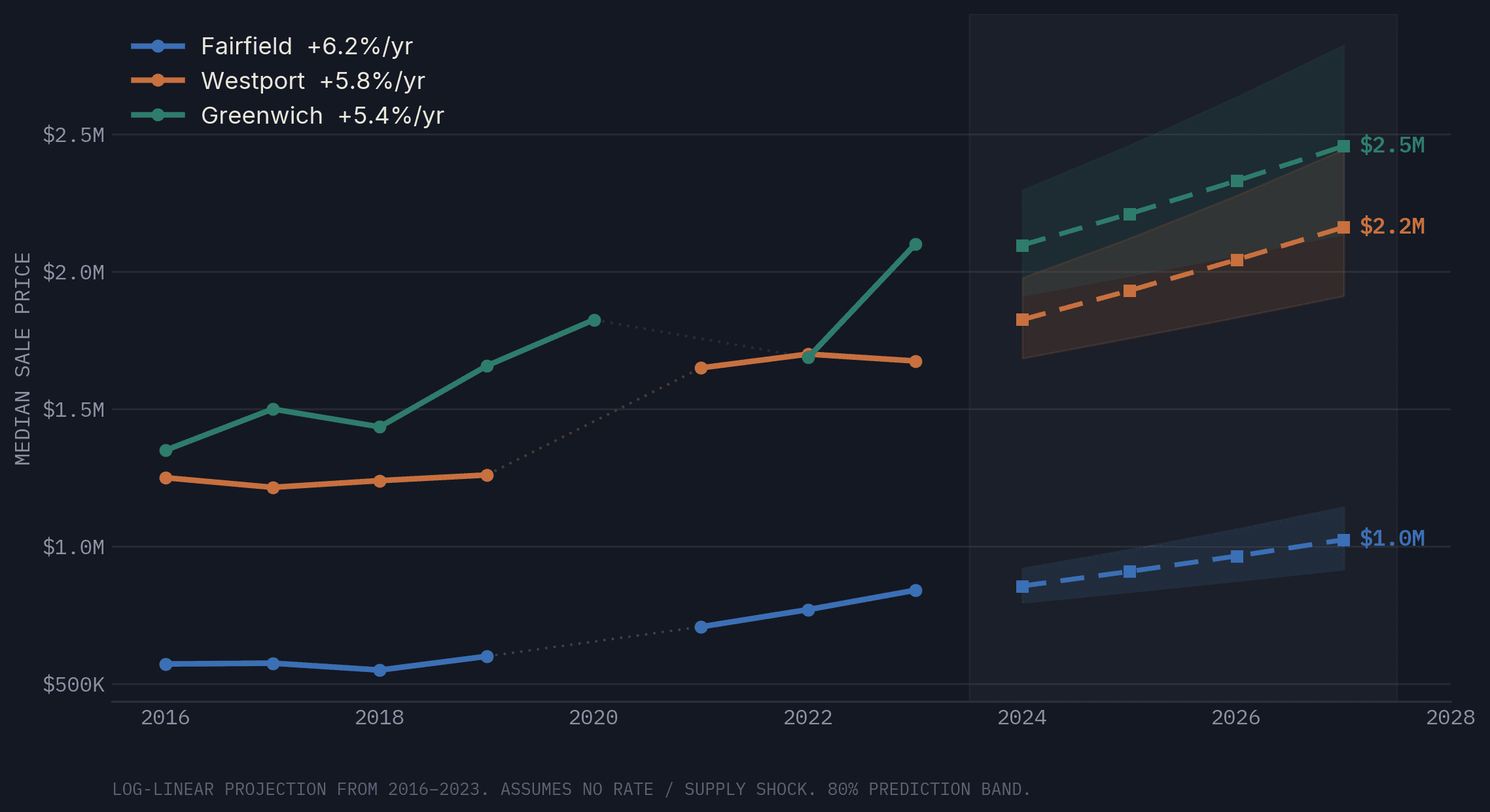
Median price forecast through 2027
Log-linear projection. Solid = observed, dashed = forecast, shaded = 80% interval.
The geography of value
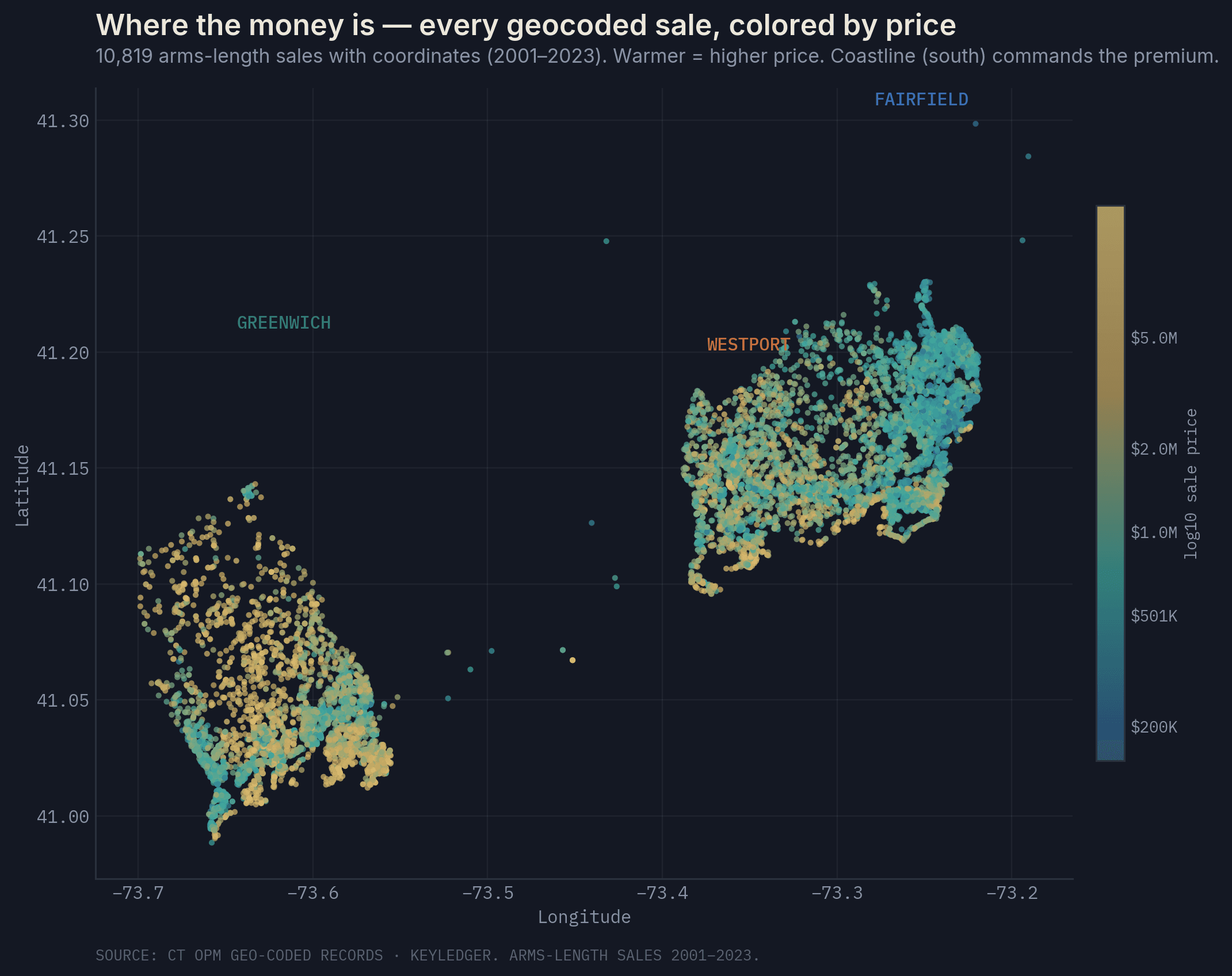
Roughly 10,800 of the recorded sales carry precise coordinates, which lets us map price to place. Plotted at their true locations and colored by price, the sales trace the towns' actual footprints — and reveal where value concentrates.
Where the money is
Every geocoded arms-length sale, 2001–2023, colored by price. Warmer = higher.
Explore every sale
Pan, zoom, and filter by price, year, and town. Click any point for the sale detail.
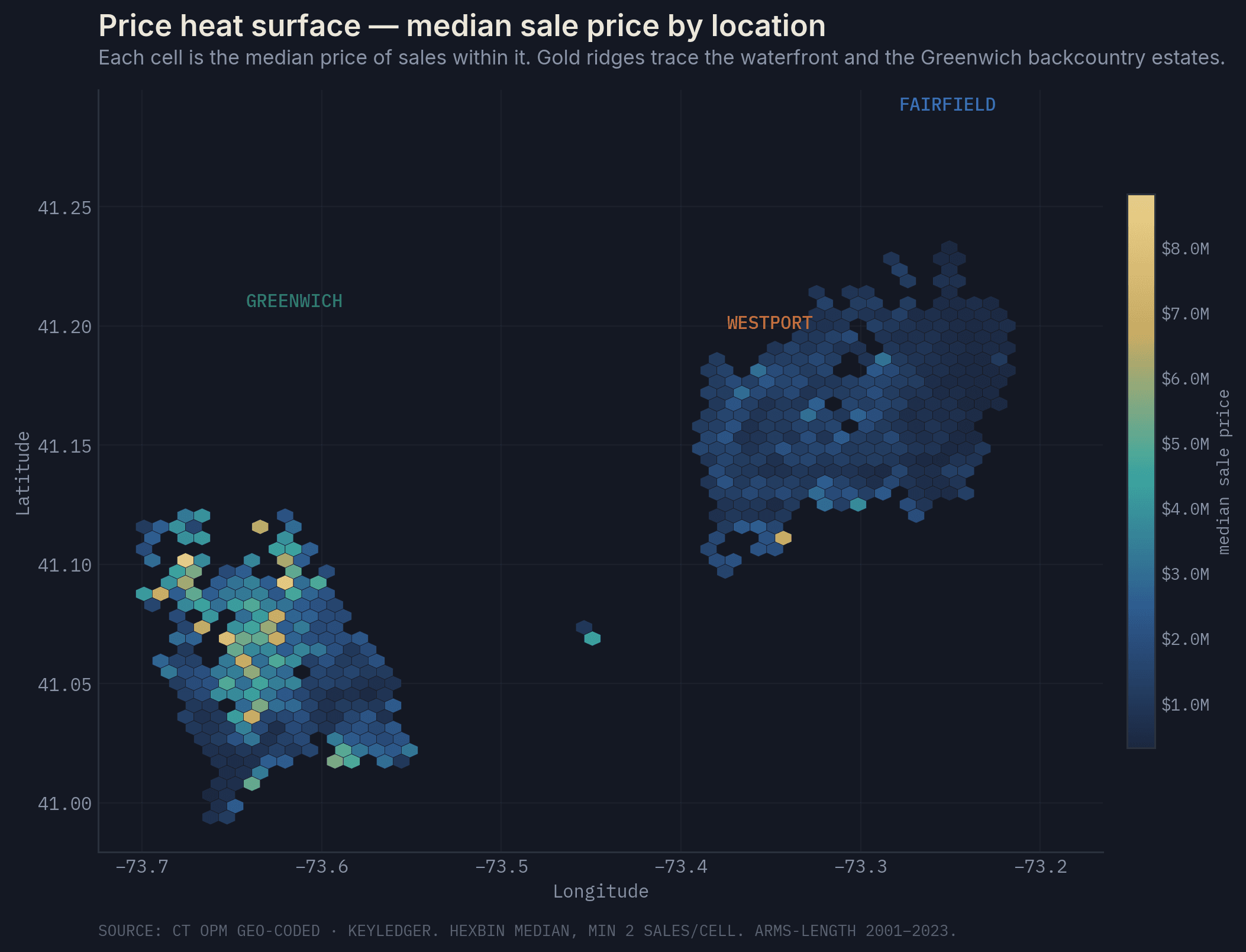
Smoothed into a heat surface, the pattern sharpens: gold ridges along select shore stretches and — strikingly — deep inside Greenwich.
Price heat surface
Median sale price by location (hexbin, ≥2 sales per cell).
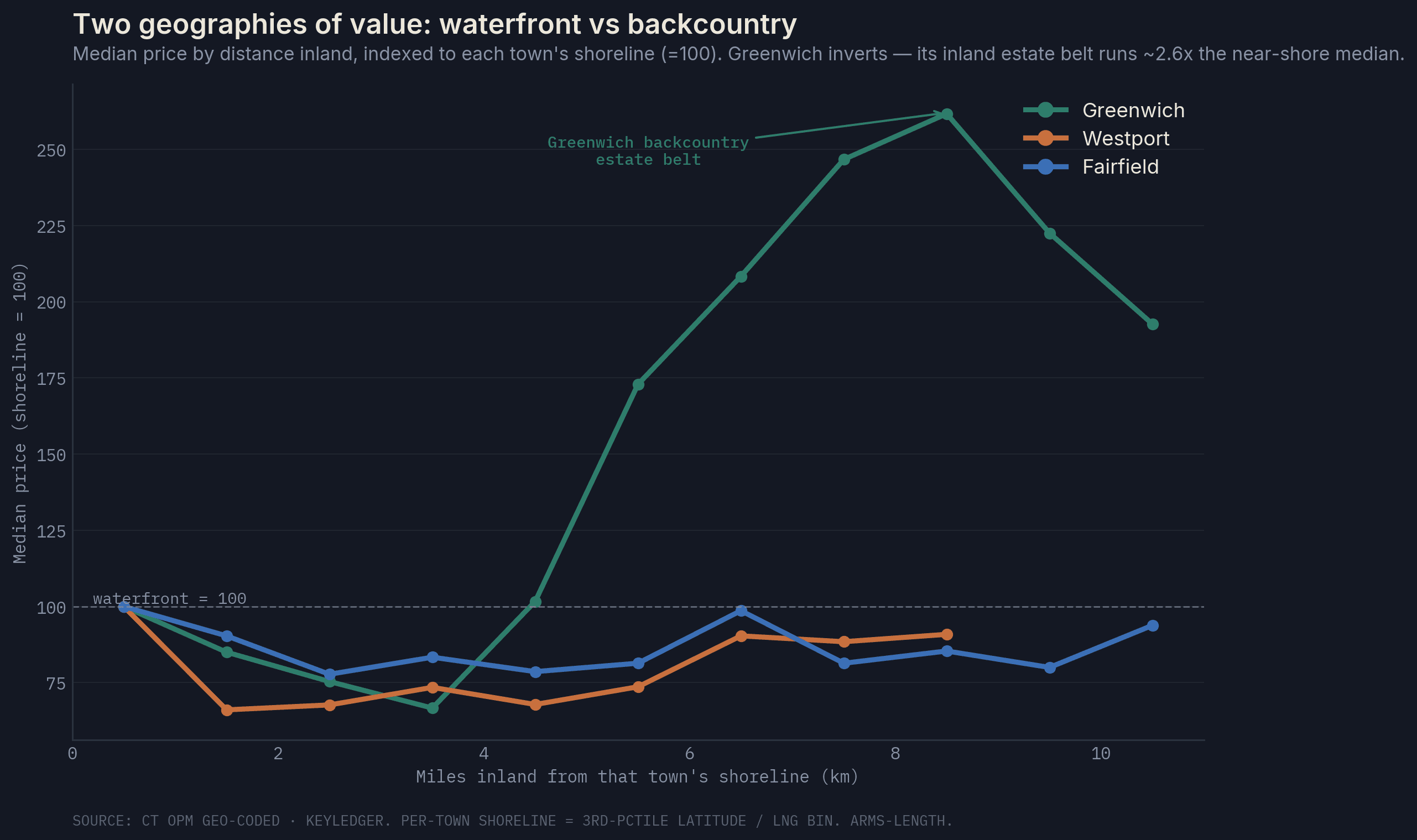
That inland glow upends the usual "waterfront is dearest" assumption. Measuring price against distance from each town's own shoreline separates the coast effect from the town tier — and reveals two different geographies of value.
Two geographies of value
Median price by distance inland, indexed to each town's shoreline = 100.
Price per square foot
Total price tells you what a home cost; price per square foot tells you what the market paid for the real estate itself. Pairing each sale with the assessor's living-area figure — newly joined for ~50,000 parcels — gives us the metric agents actually quote.
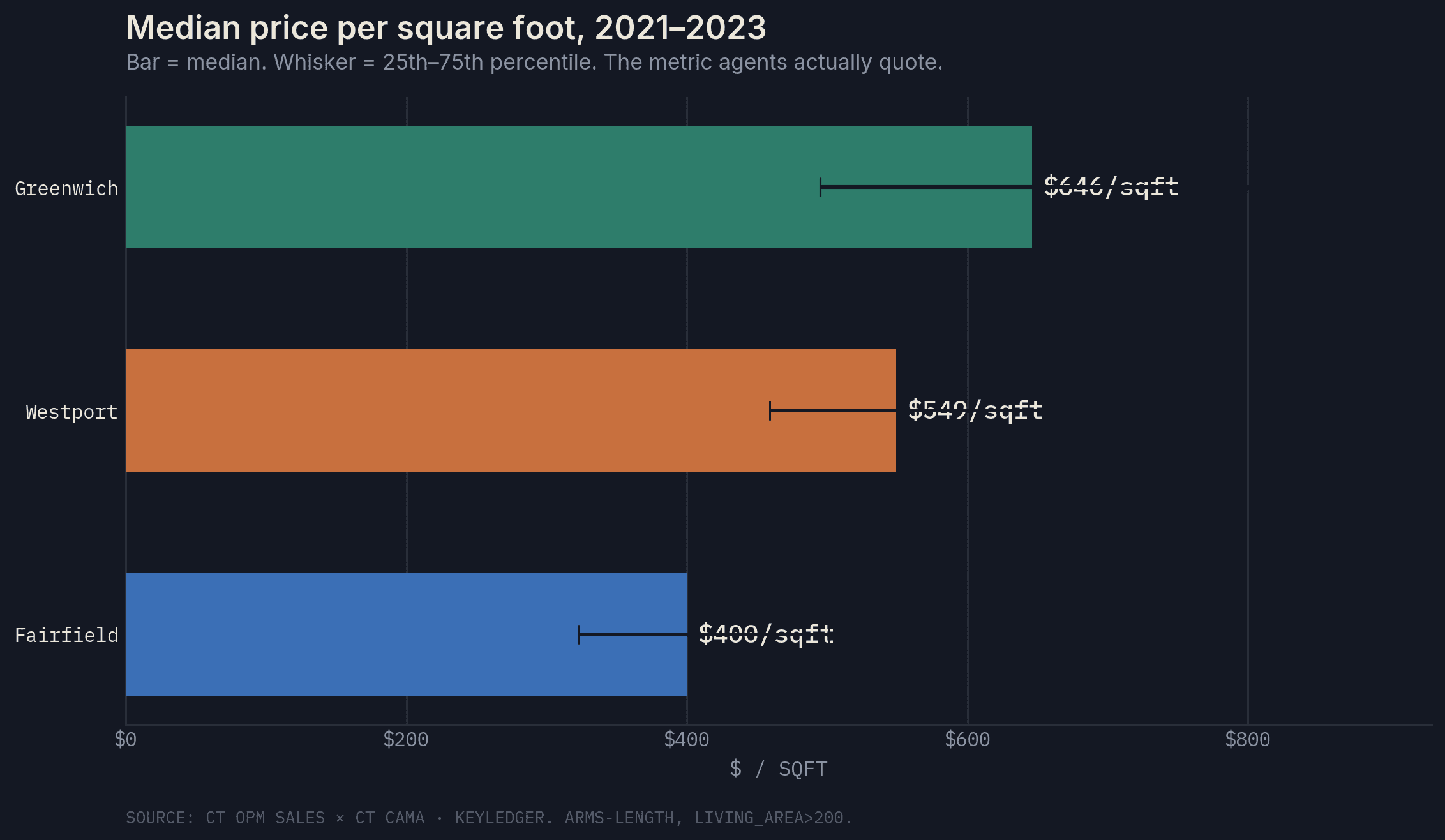
Median price per square foot, 2021–2023
Greenwich $564 · Westport $472 · Fairfield $336. Bar = median, whisker = 25th–75th percentile.
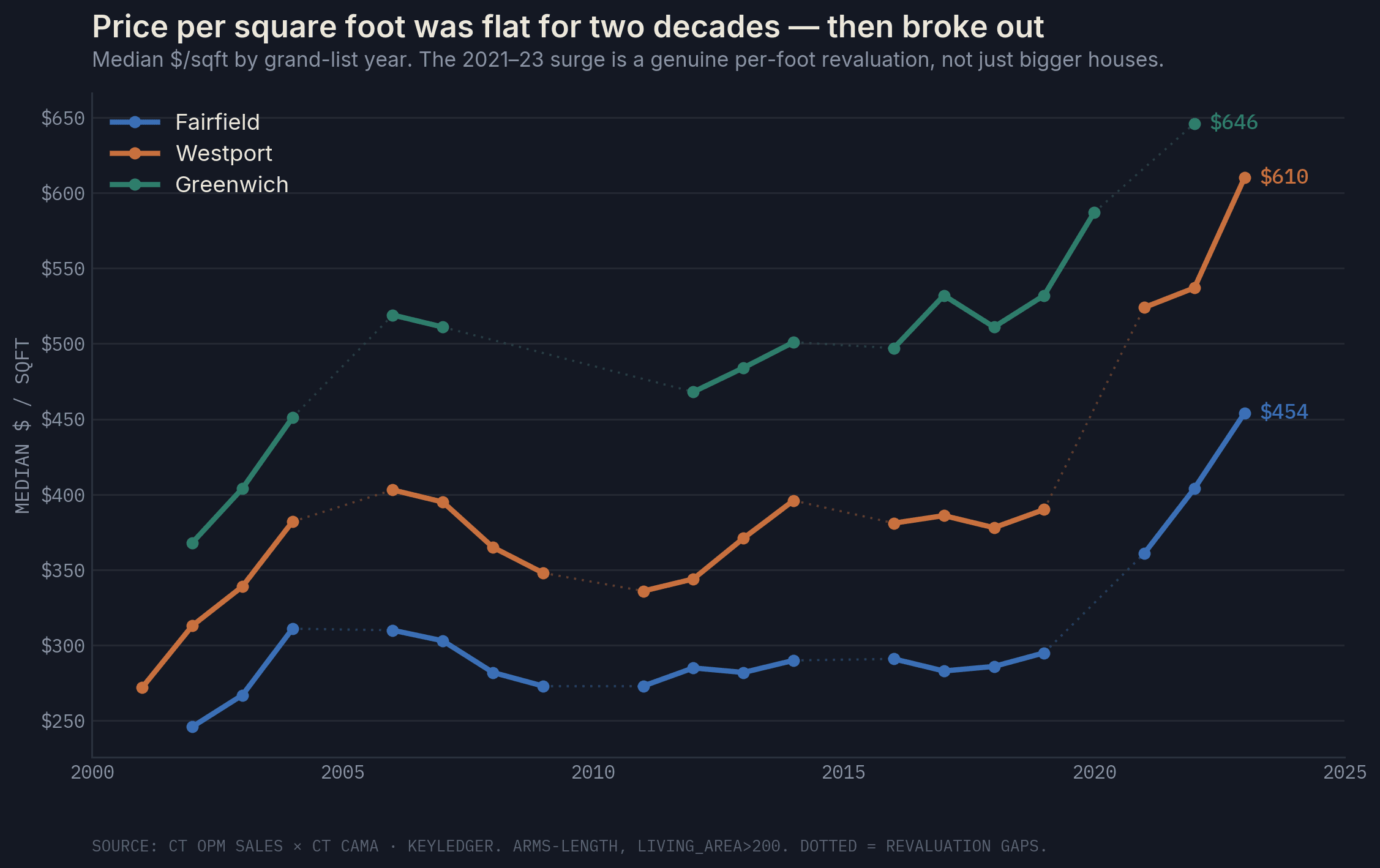
The more revealing view is the trajectory. For nearly two decades, $/sqft was remarkably flat — Fairfield held ~$280–310 from 2002 to 2019. Then it broke out.
Two flat decades, then a breakout
Median $/sqft by year. The 2021–23 surge is a genuine per-foot revaluation, not just larger homes selling.
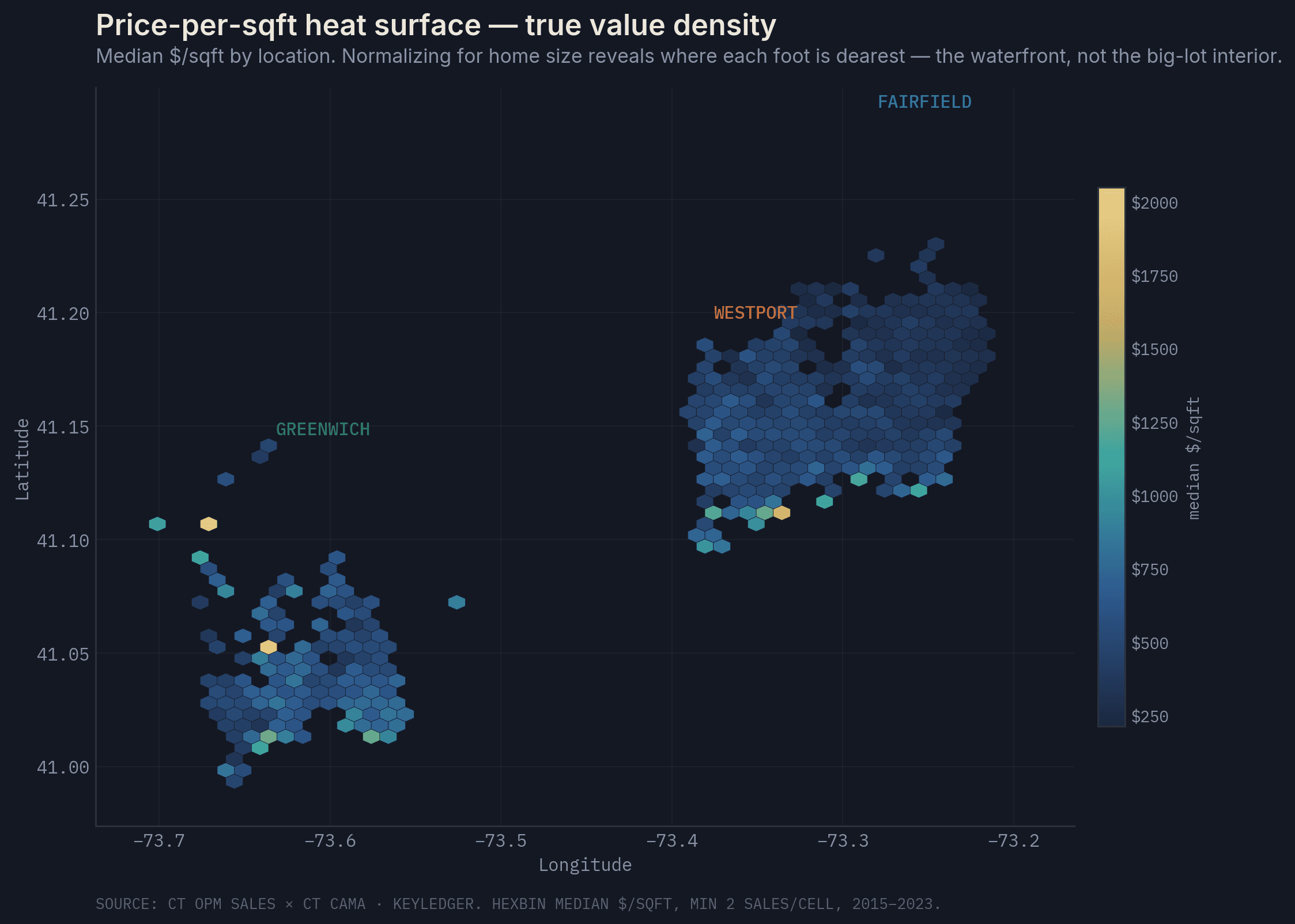
Normalizing for home size also rewrites the map. The total-price heat surface lit up Greenwich's big-lot interior; the per-foot surface moves the gold back to the water — a small coastal cottage commands more per square foot than an inland estate.
Price-per-sqft heat surface
Median $/sqft by location. True value density — where each foot is dearest.
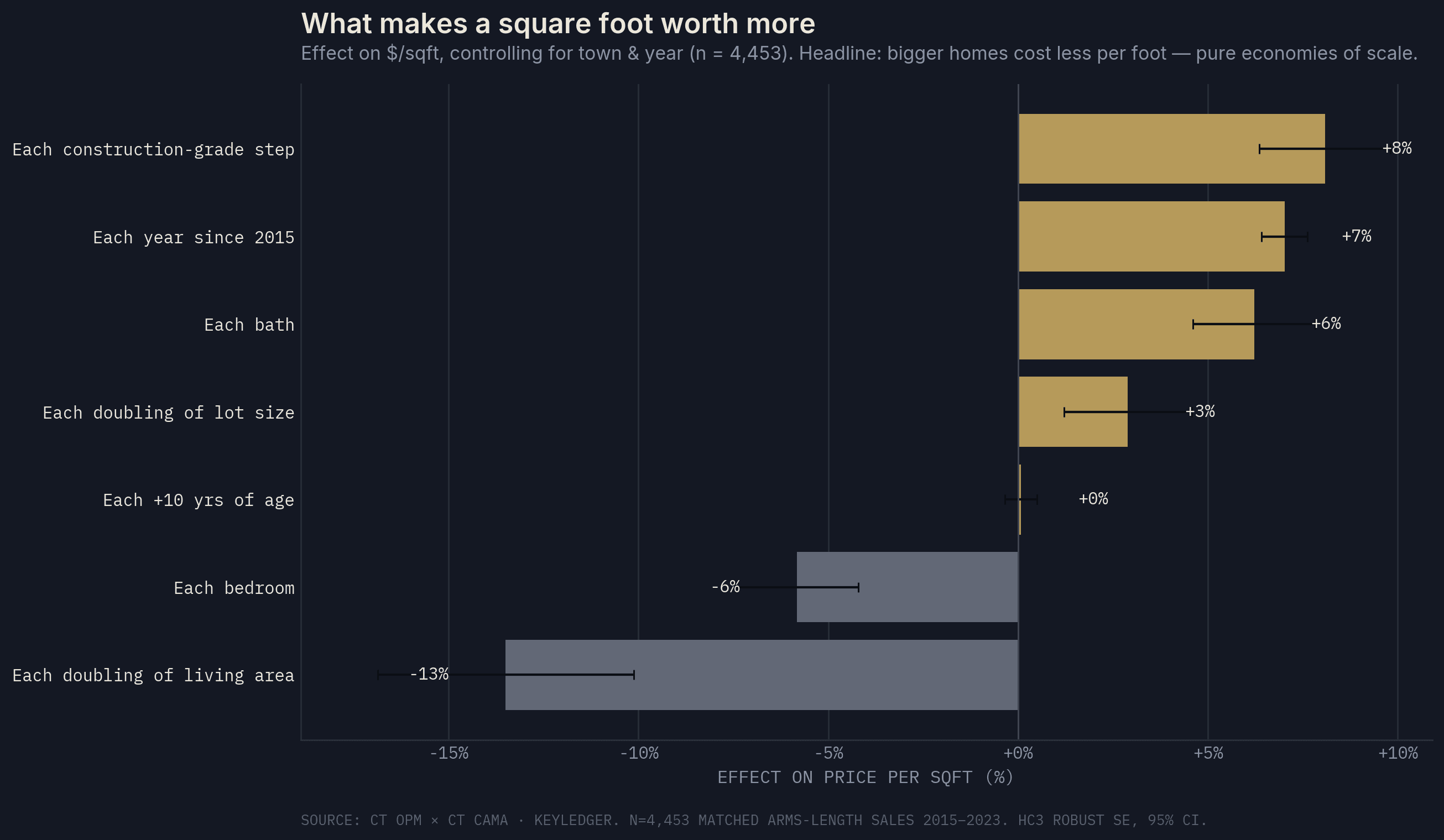
What makes a square foot worth more
Effect on $/sqft, controlling for town and year. Now with real building attributes, not just assessed value.
Inside one town: the shape of Fairfield
A single median hides as much as it reveals. Zoom into Fairfield alone — 5,160 recorded sales since 2018 — and the town stops looking like one market and starts looking like several, stacked on top of each other. The first clue is the shape of the distribution.
The shape of the Fairfield market
Sale prices aren't a bell curve. A dense cluster of ordinary homes, then a long tail of waterfront and Southport sales.
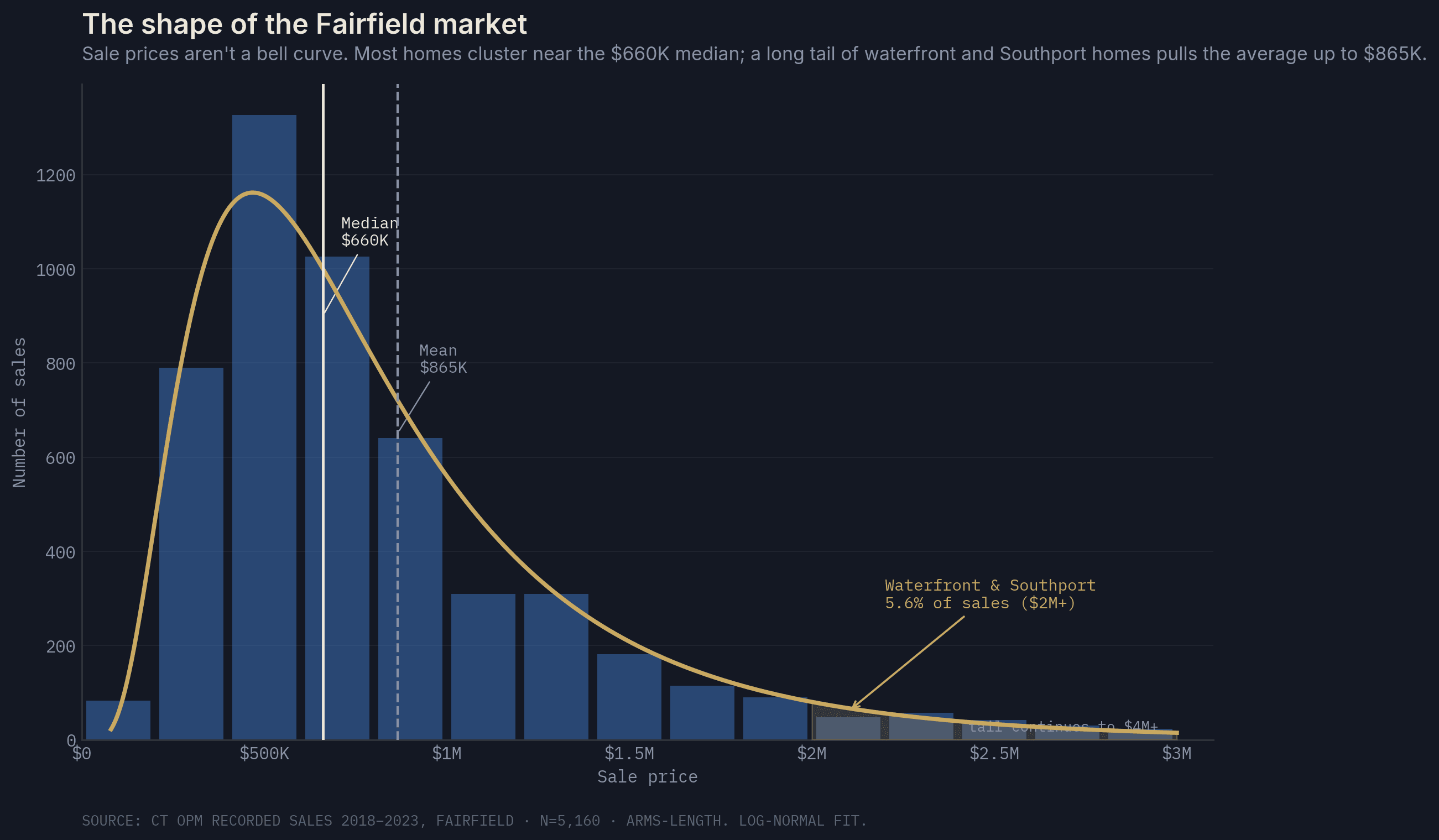
Home prices are never a tidy bell curve; they are log-normal — squeezed against zero on the left, stretched into a long tail on the right. Most of Fairfield clusters near the $660K median, but a thin band of high-end sales pulls the average up to $865K. That gap between median and mean is the whole story in one number: about 1 in 18 sales (5.6%) clears $2M, and those few do the heavy lifting on the average.
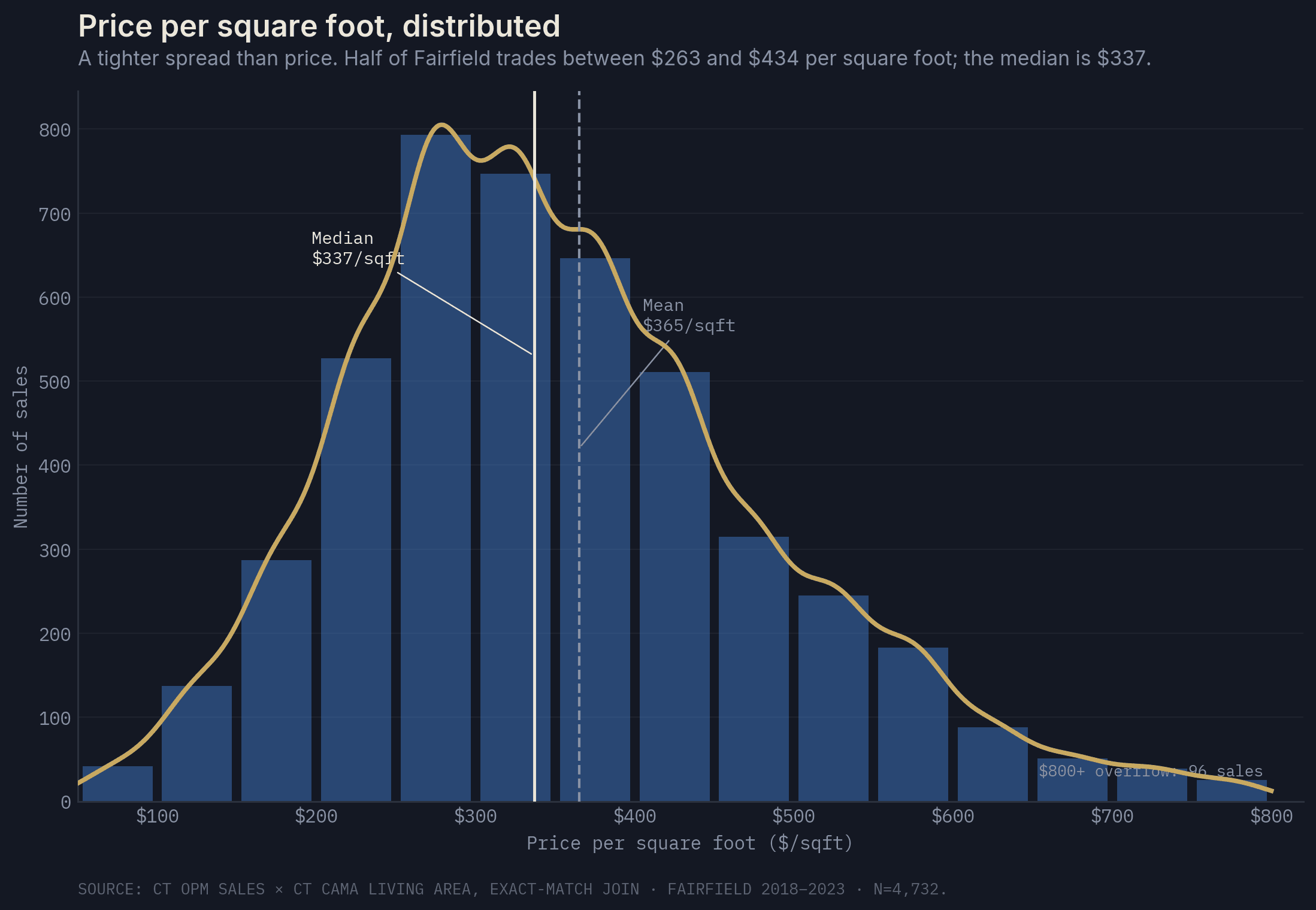
Measured per square foot, the spread tightens. Total price mixes together how nice and how big; price per square foot isolates the rate. Half of Fairfield trades between $263 and $434 a foot, around a $337 median — a far narrower band than the price chart suggests.
Price per square foot, distributed
A tighter spread than price. Most of the town pays $263–$434 per foot; the median is $337.
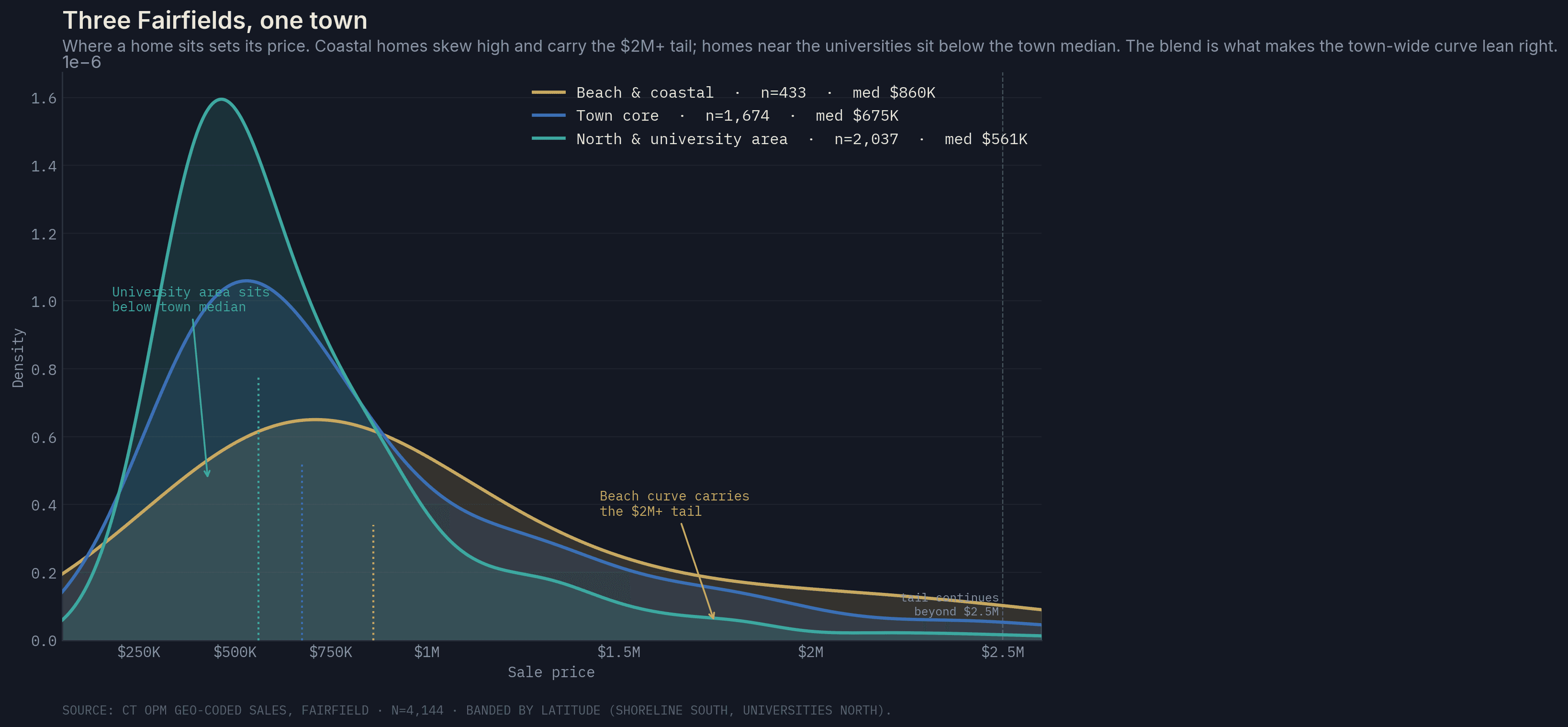
So where does the tail come from? Geography. Split the town by where homes actually sit and the single lopsided curve resolves into three cleaner ones — three Fairfields with three different centers of gravity.
Three Fairfields, one town
Coastal homes (median $860K) carry the $2M+ tail; the north and university side (median $561K) sits below the town median.
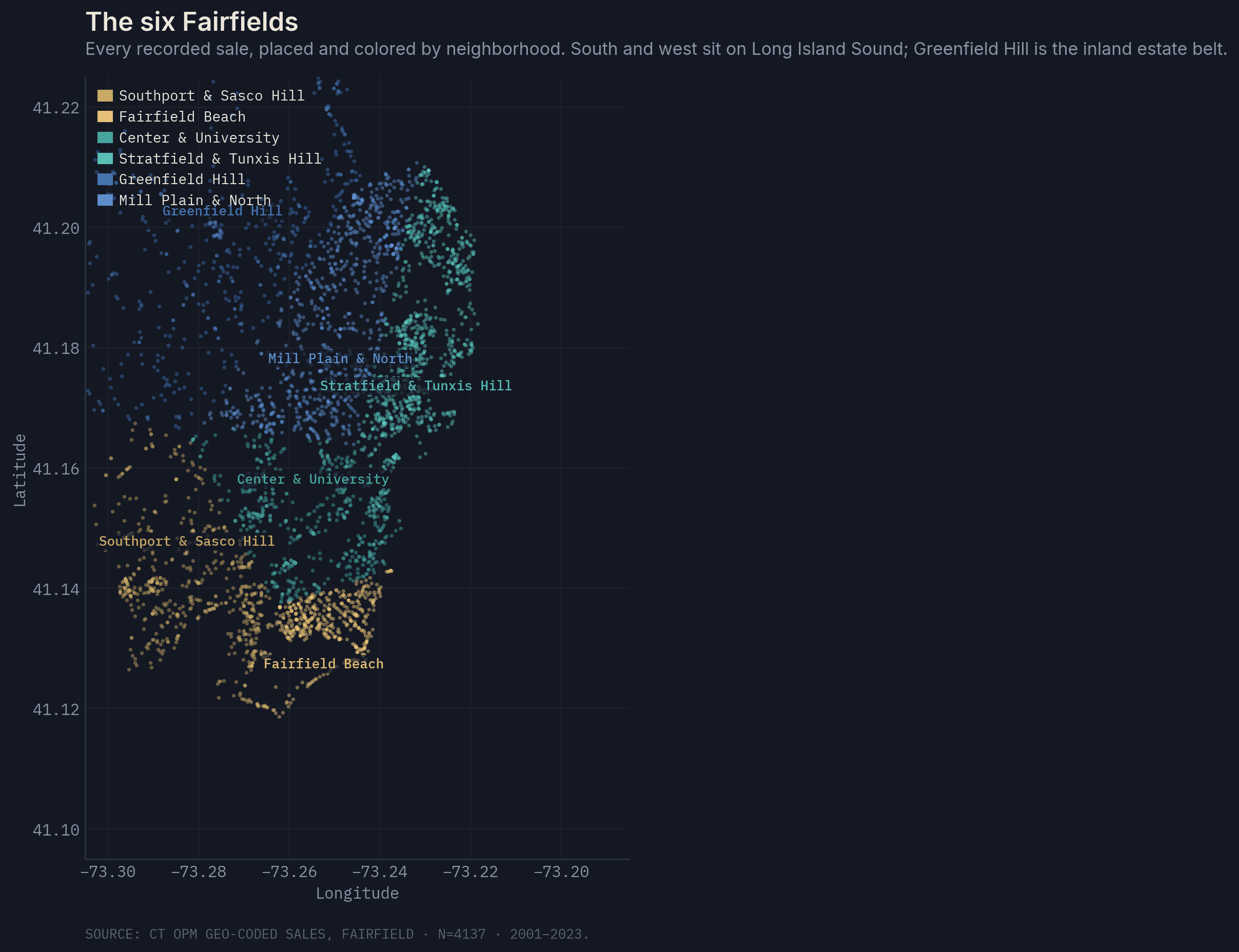
Sharpen the lens further and Fairfield resolves into six recognizable neighborhoods, each with its own price signature. Placed on the map, the logic is geographic: the south and west sit on Long Island Sound, while Greenfield Hill is the inland estate belt to the northwest.
The six Fairfields
Every recorded sale, placed and colored by neighborhood. Coast to the south and west; the estate belt inland to the northwest.
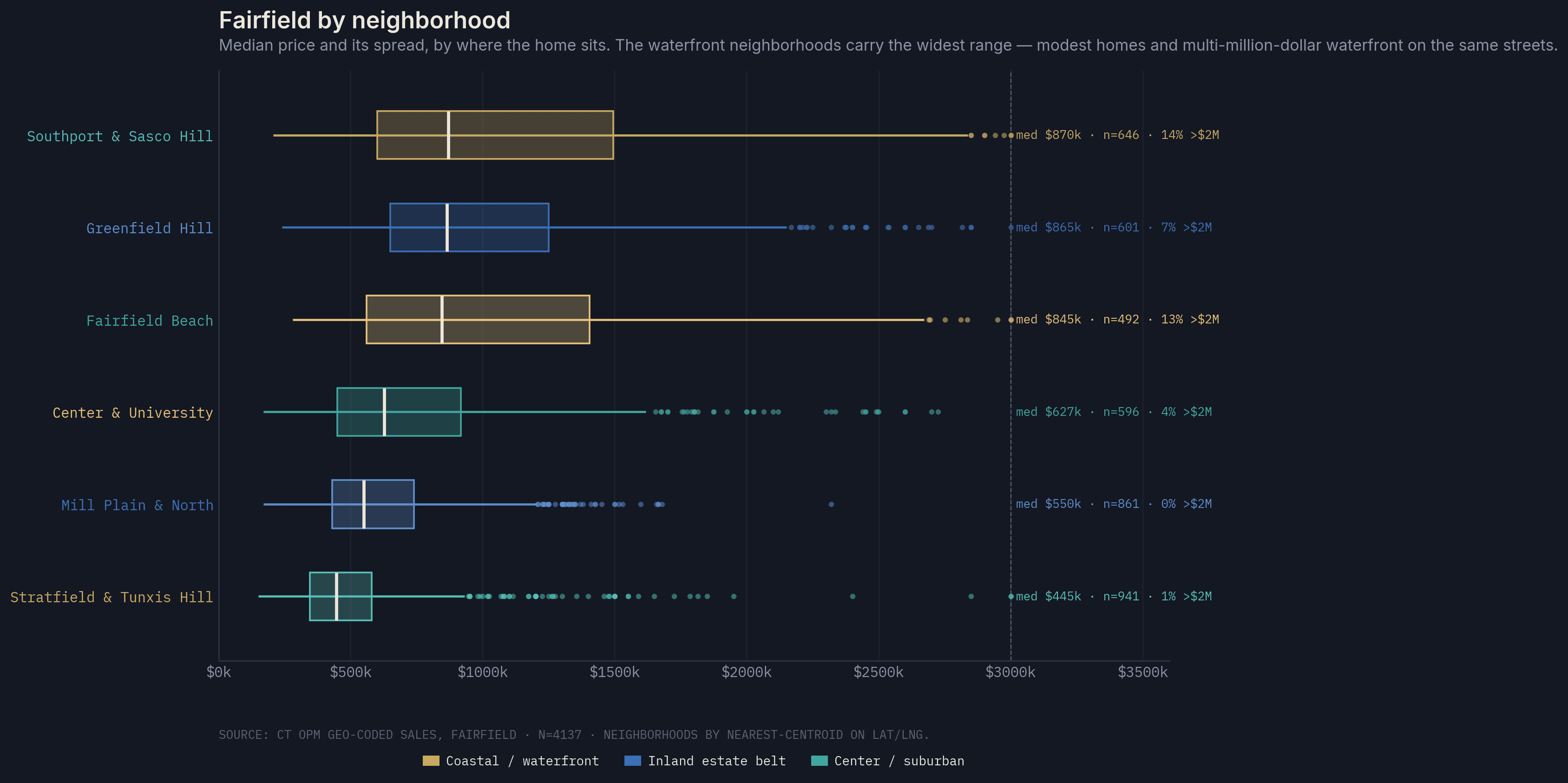
Ranked by median price, the top of the table holds a quiet surprise. Southport & Sasco Hill ($870K median) and Greenfield Hill ($865K) sit within $5K of each other — yet they are nothing alike. The spread is the tell.
Fairfield by neighborhood
Median and spread by neighborhood. The waterfront's whisker — not its median — is where it separates: Southport runs to a $3.6M 95th percentile.
Statistical appendix
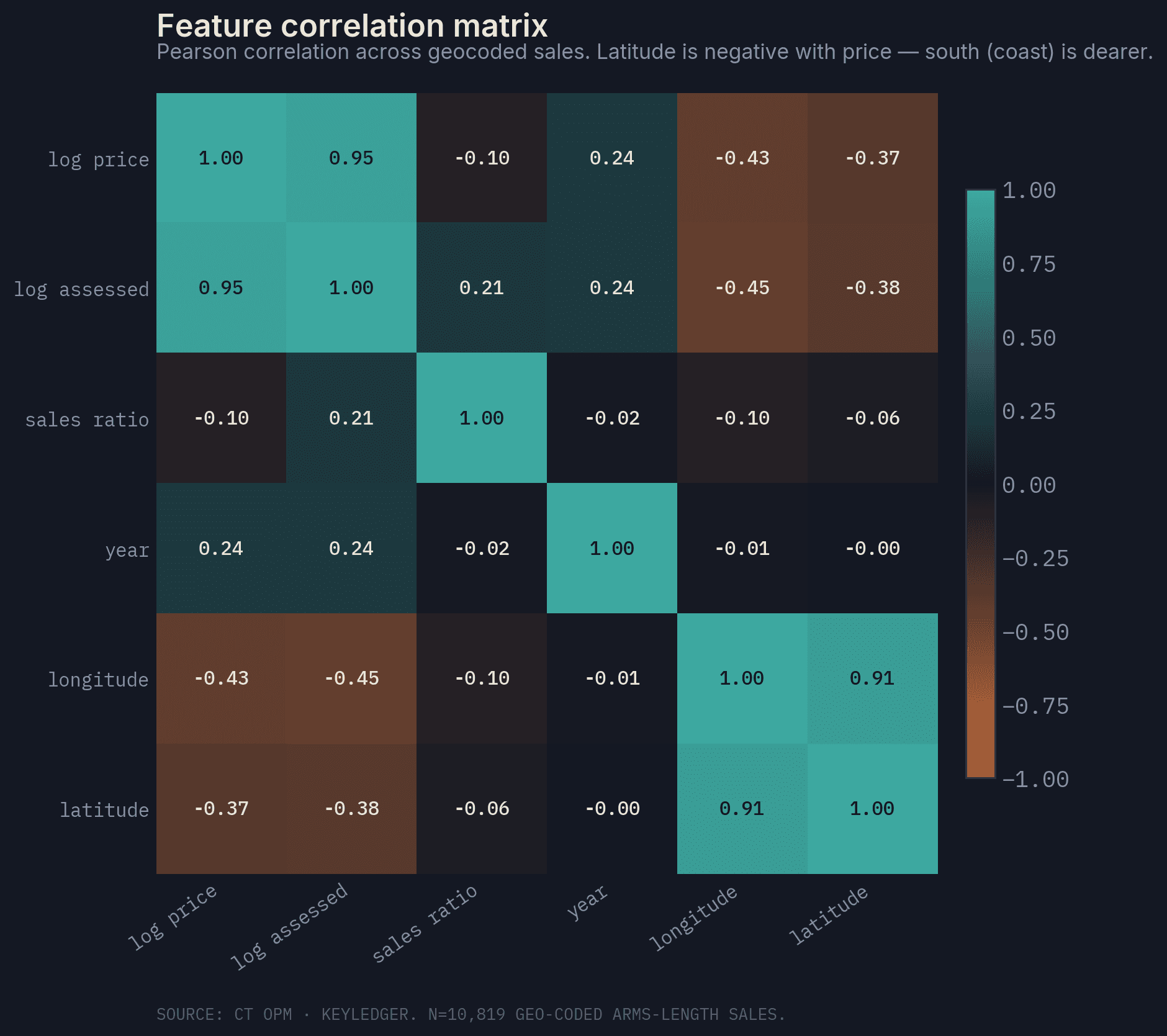
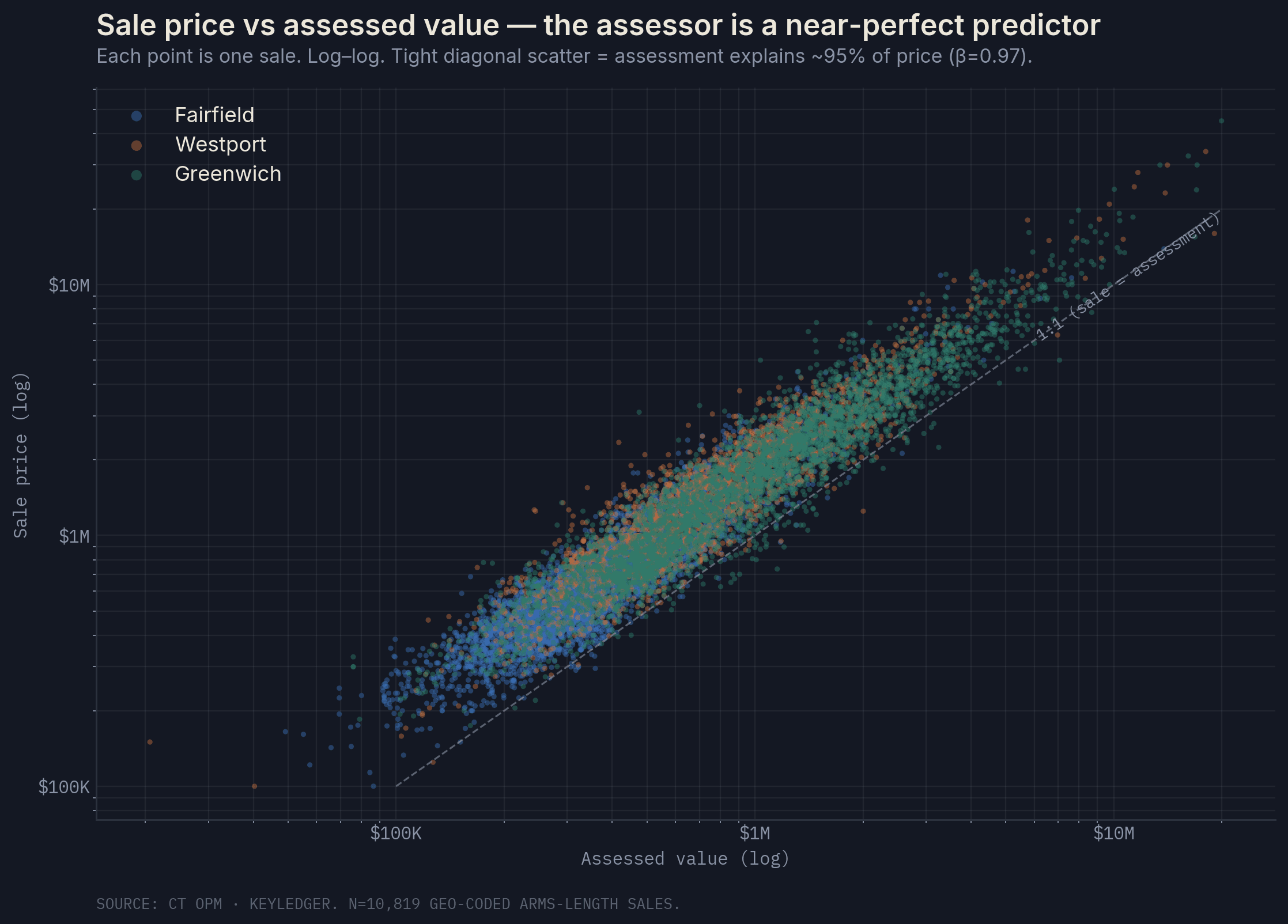
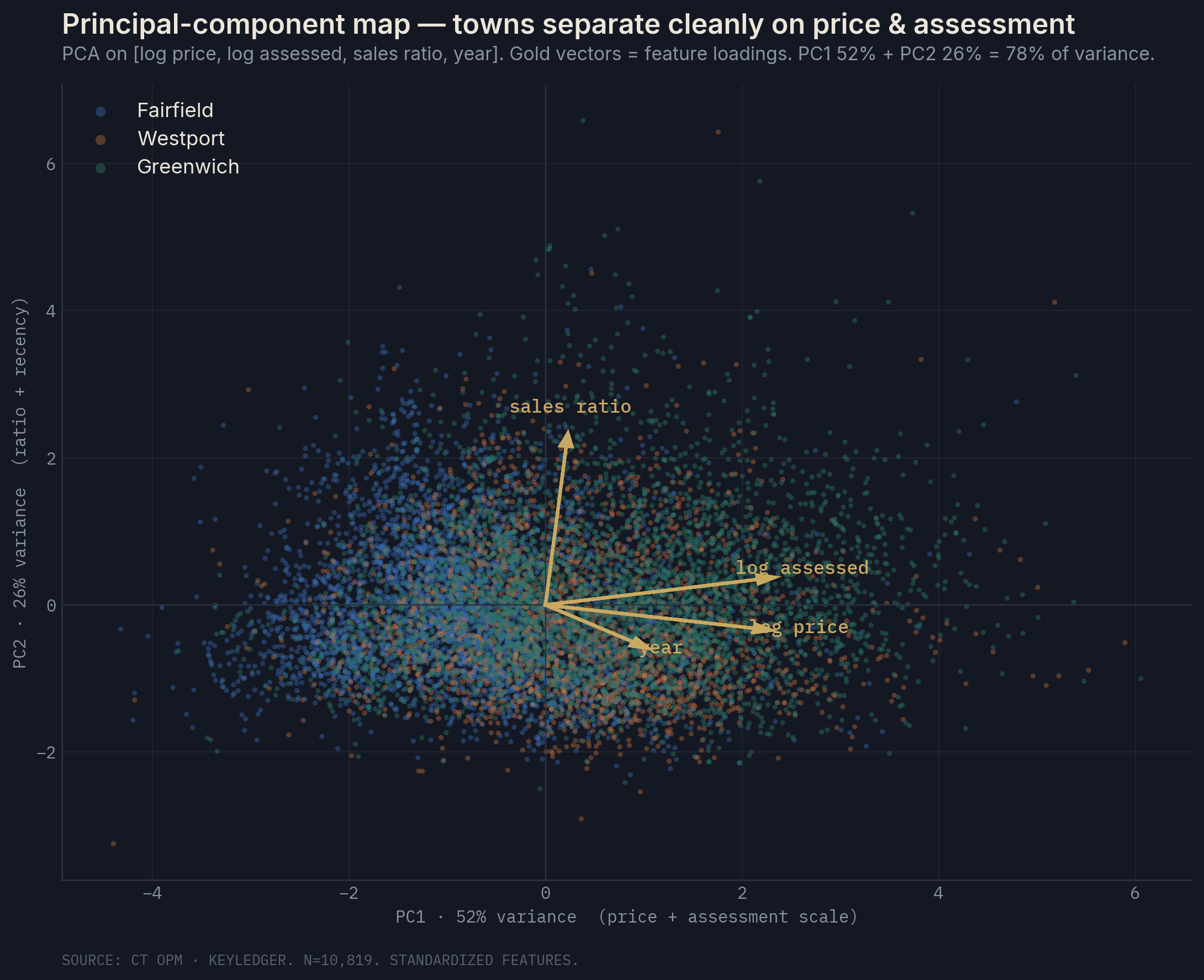
For readers who want the underlying structure: the relationship between sale price and assessed value, a principal-component view of how the towns separate, and the full feature correlation matrix.
Sale price vs assessed value
Log–log. The assessor explains ~95% of price variance (β = 0.97).
Principal-component map
PCA on [log price, log assessed, sales ratio, year]. 78% of variance in two components.
Feature correlation matrix
Latitude correlates −0.37 with price — south (coast) is dearer, all else equal.